Monday, 15 December 2014

BRICK

Brick

At the beginning of the movie, its like we are kind of brought into the middle of the film. Because the movie begins and all we can see is this young man croched down with his face in his hands, looking very worried. Then we see a young lady who is laid face down at the edge of a tunnel. This makes the audience wonder what has happened to this young lady and why is this man just staring at her not doing anything to help. This is all the information we get from the opening scene, it such a small opening which has a really big impact on the movie. 


Editing
When it comes to the editing of the movie it first starts with a a bit of music to introduce the area that they area in. It then moves at a slow pace and begins to introduce the main character in the movie. They close up to his eye level and they show his glasses to reveal the emotion in his face. It cuts and zooms all the way out, we then get to see the thing he is looking at, and we see him crouched down with his hands on his face. Then it cuts again and zooms into her shoes and the positioning of her legs, and cuts back and we see this same person again wondering what has happened and why is the young man just sitting there staring. It cuts again, then we see her hair in the water, then we cut back to the boy, then back to the young lady again and we see her hands. This leaves the audience feeling confused, because we can tell that this young lady is clearly dead,, but it leaves them wondering who did this to her? was it the young man> or has he just found her like this? If so why hasn't he helped her.
Mise En Scene
The Mise en Scene for this opening is at a tunnel, the surroundings of the place looks very dull and boring, and it doesn't look like a lot of people visit there. there hasn't been a lot of props been used in this particular scene. However the costume that the young lady is wearing makes he seem very innocent and helpless. It makes her look like she was just going to school, or maybe even coming back from school and this has just happened. We don't know.
Sound
There wasn't that much sound in this opening, seeing as the opening was so short. But there is non-diegetic sound, this when if we was to be there then we wouldn't be able to hear it. So as they are beginning the movie, the is a background music, but the music isn't a calm sound, its a kind of thriller sound. This sound carries on throughout the whole movie, to show there is a bit of suspense happening at the moment. Then the background music blends in to the next scene and then we hear the diegetic sound, which is the bell.

Friday, 12 December 2014

PRELIMINARY POST 2

Preliminary Task

  /

The Preliminary Task was to demonstrate continuity editing. We had to make sure that we used: Match on action, Shot/ Reverse Shot, Eyeline Match and making sure that we follow the 180 Degree Rule.
In my group, which included Abi and Taju. I was the one who was in charge of using the camera, and videoing what was going on. Abi and Taju were having a conversation about recruiting for a new job and she was asking the usual question that any interviewee would ask, so for example "Why would you like to work here."

So when I was filming it I had to make sure that I wasn't breaking the 180 degree rule, or else it would break the whole structure of the scene, if I do break it then its called crossing the line. I also had to make sure that I used the eyeline match, to show when Taju was walking down the corridor and he was looking at the poster. I also used the match on action showing when Taju was walking into the room and he opens the door and we could see his face as he opened the door. And lastly I used the shot/ reverse shot to show that they were both having a conversation with each other. 

Monday, 8 December 2014

ZODIAC

Zodiac
https://www.youtube.com/watch?v=Ub6wGZu5Xng

Zodiac2007Poster.jpg

The opening of Zodiac shows a young man Mike Mageau meets up with his girl/friend Darlene Ferrin and they drive towards this alleyway. When they got there they met a car, there but they didn't mean any harm we think. Then another set of cars came, and they were worried that they were in trouble, but they weren't as they just drove away. Another car then returned and this time stepped out of the car and unexpectedly shot him and the girl. We are unaware on why this happened and what caused these men to do this.


Editing 
At first it starts off slow, with someone driving around in the car introducing the neighbourhood and showing all the houses, then it stops and you see a young man running towards the car, introducing the two characters. Then they drive off through the neighbourhood into the shut off area. The camera then shows where they are then cuts into the car. Then they exchange a bit of dialogue Then a car comes and the camera zooms into the car, however we cant see who's in the car we can only hear noise. That car then drives away then we are back in the car again and they continue on with their conversation until when the next car comes along then we get a view of that car, and now the young man and women in the car begin to get worried unsure of what was taking place. That car drives away, then there is a sigh of relief, however the car then comes back and the camera zooms out so we can see the area they're in, then two young men exit the car and then approach the car. The camera then zooms into the young mans face, the he begins talking, then the camera cuts and then zooms into the gun and all of a sudden the bullet goes off, we cant see the bullet physically going into them however we can see the blood, after we hear the gun go off.
Mise En Scene
The mise En Scene includes a house where we can we can see the young man exit, to enter the car. They then enter a white car, which in those days might have been very popular back in those days. They then drive away into a little hut. Then when the second out of the three cars that came they used fireworks which they had aimed at the car, although we couldn't see who fired it off, we could see the colours of the fireworks. The reason why they may have not shown the people in the car its to probably create a sense of suspense, so it doesn't only make the characters in the car worried but it also makes the audience quite suspicious of what could happen next. The finally at the end of the opening scene, we got to see a close up of the gun, which create a dangerous atmosphere for the people in the scene. Also the fact that thy are wearing something which covers up their face it also creates a dangerous sense.
Sound
As she is driving through the neighbourhood, we get a non-diegetic sound of the radio, the reason why this is non-diegetic is because we don't know where the source of the sound is coming from. Then they exchange a bit of dialogue whilst he is stood in front of the car. As the cars approach the car park, we can then hear the engines of the other cars which are driving away, this is diegetic because we can see where the sound is coming from. They then start o have a bit of a conversation, then all of a sudden we hear the fireworks this is a diegetic sound, which ends up startling the both of them. The third car then comes along then when the guy is in front of the car we can hear the gunshot, which is non-diegetic at first because we couldn't see the gun until when the angle of the camera has changed. 

Friday, 5 December 2014

CONTINUITY EDITING

Continuity Editing

Continuity Editing retains a sense of realistic chronology and generates the feeling that time is moving forward. You can use flashbacks or flash-forwards, but the narrative will still be seen so it can progress forward in a expected or realistic way. 
Continuity Editing is very important because it relates images in a kind of logical sense. It includes invisible cuts, which no one would recognise as long as someone is always moving. When using the continuity editing it makes the cuts look like it continuos so the audience are unable to notice the cuts


Continuity cuts consist of:


Eyeline Match

This is where we see a character looking at something off screen and then we cut to a short of what they are looking at. 
For example in Star Warss


As you can see in this scene, the women is looking straight forward, then it cuts to show the stormtroopers then it cuts back to her. We would never know that she is just looking forward we would think that she is looking directly at these stormtroopers.

Match on Action

This is where we see a character start an action in one shot and then see them continue it in the next shot. 


With this you can see the young lady is walking toward the stairs, then cuts to show her walking up the stairs, it looks like there is a camera on either side but there isn't. It films her walking towards the stairs, then it cuts and then it films her walking up the stairs.

Graphic Match

The graphic match shot is when two shots are linked with a similar shape or composition of an image. It also puts shot together.

In this shot, you can see it start with the microorganisms then it blends in and we see the tear drop on the leaf and then it turns into the earth. This is a graphic match because it looks like it been blended in together but its two different shots which are linked together.

180 Degree Rule

This is a basic guideline that states that two character (or other elements) in the same scene should always have the same left/right relationship to each other. If the camera passes over the imaginary axis connecting the two subjects it is called crossing the line. 


However if you fail to follow this then you have broken the 180 Degree Rule for example in the Hunger Games they deliberately brake the 180 Degree Rule.

Shot/ Reverse Shot
Which is mainly used in conversations / arguments.


Tuesday, 25 November 2014

NO COUNTRY FOR OLD MEN

No Country For Old Men


The opening for No Country For Old Men begins with a voice over, with a man stating his opinion on life. We the get to see a beautiful sunset or sunrise, which makes the audience think that everything is calm and humble. We then notice that there's not that many people within this place, meaning if anything was to happening the no body will no about it. The man talking then begins to talk about the appalling crimes which takes place there, at first the beautiful scenery got the audience believing that everything was calm but it actually a bad place. Afterwards we see a Sheriff put someone in the car, we don't know who he is and what his part is in the movie. Which then takes us to jail, where the man placed in the police vehicle murders another man. He then escapes, and gets into the police car, takes off and kills another man.


Editing
In the beginning the moving had a very slow pace to it, introducing the beautiful scenery however its also showing us how deserted the place is.It then begins to pick up pace when the man gets arrested and put into the police car. When we get to the bit where he's in prison, the editing then gets faster, this is to show that there is a sense of trouble, which there was when the man was killing the officer. There was especially a fast editing when the officer was struggling because he man had to put in a lot of strength to try kill him. It then began to slow down when he got into the car, all of a sudden he stopped this man, then he pulls out this gas pipe and we get to see it in a different angle him placing it on the mans forehead and all of a sudden the man get killed.
Mise En Scene
The Mise En Scene concludes of a beautiful scenery to begin the movie. It then goes onto showing a police car with a man being placed into the car. It then changed and went into the police cell with the man being killed. The killer then leaves the police office and then gets into the car and then begins driving away and then stops at a whole different scenery. Then the scenery changes again to the near a farm, where a man is hunting a couple of deers, the he walks away after missing and then walks to another area where there is all dead bodies on the floor.
Sound
At the beginning there isn't as much sound as we should normally expect. It begins with a bit of dialogue, with the man speaking about his life. Whilst he's talking it cuts to a different image each time. We then see the police car and we can hear the police radio trying to bring through some information. Then the man enters the police car and then drives away, to the police office, where we can hear the diegetic sound of the police man talking on the phone. When the man then begins to strangle the officer, we can hear the officer struggling and little and the sound of his boots hitting the floor. 

Monday, 24 November 2014

OPENING SCENE OF THE HISTORY OF VIOLENCE

The opening Scene of The history of Violence
https://www.youtube.com/watch?v=WokcHt5UQ-M


The opening scene of this movie is very important because we know who the main characters of the movie are, and we also get a sense of the character they will play. In this movie the opening starts with two men walking out of a restaurant and the surroundings of the area is very quiet. They get into the car and they realize they had run out of water, so the young man went back into the restaurant to get water. Then we notice the blood on the counter, and the two people shot dead on the floor. 
This then brings us to the conclusion that these two men were murders. 

Editing
The Editing of the movie starts off very slow in the beginning. introducing the neighborhood of their area and the two characters Leland Jones and Billy Orser. It then started to speed up when the young man went into the room to get water. It speed up whilst showing the surrounding of the motel and all the belongings that they own. 

Mise en Scene
The Mise en Scene concludes of a blue car, in which they use to drive them to their locations. There was a smartly dressed man and another man who was just wearing casual clothing, this shows to us that the man in the dressed in a smart suit is in charge of the man in the casual clothes. The settings of the opening is at a motel, they may have used this setting because a lot of killings usually happen at motels. Also the area of the motel was very quiet which makes the audience feel on edge, it also creates a sort of mysterious atmosphere.There was also a gun used in the opening showing that there is going to be violence in this movie as well as the title, it also shows to us that there is danger. Then we see the little girls doll, this is a comfort toy for the little girl seeing as her parents have just been murdered. This makes the audience feel more sympathy for the child, because there is nothing that she can do excepts cling onto her doll. 

Sound 
At first we are introduced with a drilling sound this is a non-diegetic sound seeing as we cannot see the drilling but we can hear it. Then there is the dialogue which goes on between the two males for a little while. Then there's the diegetic sound of the radio, we can see the source of sound which is why it is the diegetic sound, and also the sound of the car counts as a non diegetic sound as we can see that the sound it coming from the car. The man enters the restaurant, then as soon as we see the blood all of a sudden here is a backing track to show the suspense and tension of whats happening in that precise moment. Then there were little sounds being picked up for example the sound of the fly when the body were shown, this is a non-diegetic sound because we can hear the sound of the fly but we cant see the fly, and then the sound of him pouring water into the bottle, this is a diegetic sound because we can see him poring the water into the bottle. And lastly there's the diegetic sound of the gun being let off. 

Camera
At the beginning he used the tracking shot to show the surrounding of the neighborhood, it shows that the country that they are in is hot and mild. Then there's a steady shot when the two men are in conversation, this is to show that there's no drama happening at this moment. But then he goes into a Pan Shot when he is showing the whole of the restaurant, he scans around the whole room to show all of the contents in the room. Then there is a low angle to make the man look bigger and more powerful and in control, this was shown when the little girl appeared out of no where. He then used a point of view shot as he walked toward the little girl, then there was a extreme close up of him handling the gun. 

Friday, 21 November 2014

EDITING INTRODUCTION

Editing - Introduction 

Editing is the process of looking at all the footage shot during the making of a film/ TV programme and placing it in the desired order. 

There are two key areas to concentrate on when editing:
  1. The Speed of Editing, so this means how long will each shot last. 
  2. The Style of Editing, so how each shot is joined together to the next. 


Speed of Editing

The Speed of Editing will help to determine the mood of whats taking place on screen. So for example if the audience is feeling anxiety and suspense, this means that the editing will be quick, the scenes and shots would be changing very quickly in order to keep up the suspense the audience will be feeling. As the film progresses the scenes may become shorter as the editing cuts between telling two or more story-lines at the same time.   

When it comes to the Speed of Editing there are two things you will need to consider:
  1. How quickly or slow the shot appears or a sequence. 
  2. How long they will appear on the screen if used. 

Style of Editing 

The style of Editing is how each shot are linked together to form the scene. Its also the movement form one shot to the next, in other words this can be called a Transition

There are five ways in which you can link to shots together, these consists of:

Straight Cut
  • This is the most common and "invisible" way of forming a transition 
  • it works when one shot moves instantaneously to the next without attracting the audiences attention. 
  • The Straight Cuts help to retain reality, they do not break the viewers suspension of disbelief.
Hers's an example of a Straight Cut:


Dissolves
  • This happens when you fade one shot off the screen whilst another shot is fading in.
  • The audience will then be able to see both shots on the screen at the mid-point of the dissolve.
  • Its used if the film maker wants to show a connection between two characters, places or objects. 

Here's an example of the Dissolve Shot by Citizen Kane:


Fades
  • This is where there is a gradual darkening or lightening image until it becomes black or white.
  • One shot will fade until only a black or white screen will be seen. 
  • Its used to indicate the end of a particular section of time within the narrative. 
  • And it shows the passing of time. 
Here's an example of a Fade Edit:


Wipe Cuts

  • This is when one image is pushed off the screen by another image
  • This style of cut is normally used in science- fiction films such as Star Wars. 
Here's an example of a Wipe Cut:

Jump Cut
  • This is used when the audience's attention it brought to focus on something which has just all of a sudden happened. This occurs when the continuity editing is broken, also known as discontinuity. It makes it come across as the scene has been removed. So for example in the movie Breathless it gets used quite often. 
Here's an example of a Jump Cut:


Tuesday, 18 November 2014

UNKNOWN (2011)

Unknown (2011) 

Facts:
  • Director Jaume Collet- Serra
  • Writers Oliver Butcher (screenplay), Steven Cornwell (screenplay)
  • Stars Liam Neeson, Diane Kruger and January Jones
  • Budget: $30,000,000(estimated)
  • Opening Weekend: $21,856,389 (USA) (20 February)
  • Gross: $130,786,397 (Worldwide)(12 May 2011)


This film is very recent, meaning that the quality of the film will be more improved then the other movies which I have posted. You can tell by the poster that its a recent film because of  the moderate editing of the poster. It looks like they have put in a lot of thought into editing the poster. In some way just looking at the poster you can tell that the movie is going to include some sort of action, especially with the actor Liam Neeson being involved.
 The movie is about a man who has forgotten his suitcase at the airport, as he returns back to go get it, it resulted in him being in a accident and being placed int a coma for 4 days. When he wakes up he tries to get his life back together but he cant, because another man has stolen his identity nobody recognizes who he is not even his own wife. With the help of a young women and old man he hopes to prove who he is.

The film has the essential characteristics of a good thriller, it includes so many different moments of tension. For example when he was in the hospital, and he had just come out of the MRI Scan. There was a person who tied him to the hospital and was trying to kill him. He was trying to reach for the scissors whilst the guy was in another room. This created a lot of suspense because everyone was wondering whether or not he was going to get the scissors in time to set himself free before the man came back into the room. The soundtrack had also caused a build up of tension, especially with the use of disoriented sounds.

There's also the scene they're in the Club trying to escape from the person who's trying to kill him. But this time he wasn't alone, he was accompanied by the young omen who had saved his life in the accident. This scene was effective because they had the use of loud booming soundtrack, disorientating the music causing a threatening atmosphere. The screen is also blacked out, the only thing we can mainly see is the shadows of other people. The viewer feels as confused as the main character does, because the don't understand how this man has lost his identity and why there are other men trying to kill him.

The movie definitely does include the Vladimir Propp, it includes the Hero, Villain, Helper, Princess and you could say it includes the False Hero. So in this case you could say that that the Hero is the first Martin Harris to star in the film, and the villain is Professor Rodney Cole who was the person who set up the whole thing, when he found out that Martin had forgotten his identity he put someone in replacement and tried to kill Martin off so that he wouldn't interfere.You could also say the Rodney Cole is also a false hero as he pretends to be Martins friend at first but then he tries to kill him. And you could say that the Helper is the old man before he died, he tried to help Martin identity  who he was but unfortunately he died which left Martin having find out who he was by himself. And the Princess in this movie will be the Eastern European girl Gina who Martin was very protective over.

Tuesday, 4 November 2014

THE BIRDS

The Birds (1963)
Down below is the trailer of another on of Hitchcock's Thriller movies:
https://www.youtube.com/watch?v=mPC_Mp0Y9WM

In the trailer, you can see that everything starts off all calm and humble with the actress Tippi Hedren in the store and also visiting the primary school. But the all of a sudden see these birds and you find out that the hundreds birds are going to be attacking the public. The movie contains typical thriller aspects such as suspense, tension and excitement. When you see the title you wouldn't think that the movie will turn out to be a thriller movie, you would think that it would been any ordinary film. Even the poster doesn't reveal a lot about what the movie will contain.

 The Birds original poster.jpg
You can only see the main actress Tippi Hedren, with a lot of birds surrounding her, you wouldn't be able to make out exactly what the movie will be about.

The Birds is a movie created in 1963 its a Horror/ Thriller which goes on for about 119 minutes. the film is directed by Alfred Hitchcock and was written by Daphne Du Maurier (Story) and Evan Hunter (Screenplay). It contains films stars such as Rod Taylor who played Mitch Brenner, Tippi Hedren played Melanie Daniels and Suzanne Pleshette who played a local school teacher Annie Hayworth.

This film contains an external threat which is coming from nature, this being the birds. Usually in Hitchcock's movie there's no where to hide, for example in Bodega Bay, when Melanie goes to visit the local restaurant and the birds begin attacking , when all the people in the restaurant ran out they had nowhere to hide, meaning they were attacked by the birds.


"Thrillers are characterized by fast pacing, frequent action" they say, this is shown in the scene from the movie birds when Melanie Daniels is in the children's playground and she sees the birds, so she runs in to the tell the children. they then have to go and find a way to escape, so the run out of the school and they run to the hotel. But along the way the birds begin to attack, this creates a sense of suspense and confusion towards the audience, because they will be thinking what is causing the birds to behave in such a way.


In this movie you could say that Mitch Brenner is the hero as he does try and make sure that everyone is safe, especially in the house when he boarded up all the windows and doors to protect his family from the birds getting into the house. And the villain of course would be the birds, there is hundreds of birds and there's fewer people making the birds more equipped and ready to attack the people.

Suspense is used extensively within the movie, especially right at the beginning  when Melanie is on the boat on her way to Bodega Bay on her way to visit Mitch and then all of a sudden out of nowhere this seagull appears and begins to physically attack Miss Daniels, this leaves the audience startled and confused as to why this happened as birds don't usually do this.

Dramatic Irony is when the audience knows something that the characters within the movie don't know. So for example in the school yard scene, Tippi doesn't know that the birds have gathered behind her, bus us the audience when the turns away from her we see that the is a lot of birds at the back of her that she doesn't know about.


In the Schoolyard scene the underlying score of the innocent child's song is in contrast to the evil in the nature. Tippi Hendren's character is only guilty of being taken for granted. In The Birds scene outside the cafe the high camera angle is like the gaze of pitiless God who cannot be bothered to intervene.
In the movie there isn't really a villain or a hero, the movie is mainly about these birds attacking the humans for no reasonable reason. I guess you could say that Mitch is presented as a hero towards the end, when he helped him and his family escape from the birds and get them to the hospital after Miss Daniels had been attacked.


Did You Know? 

The scene where Tippi Hedren is ravaged by birds near the end of the movie too a week to film?
And also the birds were attached to her clothes by long nylon threads so they couldn't get away?
Interesting!

The film features about 370 effect shots. The final shot is a composite of 32 separately filmed elements. A number of endings were being considered for this film. One that was considered would have showed the Golden Gate Bridge completely covered by birds.
The film does not finish with the usual "THE END" title because Alfred Hitchcock wanted to give the impression of unending terror. At the end we never found out what it was which caused the birds to attack the humans, it was an unsolved mystery.

When the audience left the film's UK premiere at the Odeon, Leicester Square, London, they were greeted by the sounds of screeching and flapping of the birds from loudspeakers hidden in the trees to scare them further.It will give them a bit of suspense, and leave them wondering what this film could be about.

The actress Tippi Hedren was actually cut in the face by a bird in one of the shots. People thought that Alfred Hitchcock had a thing for blondes, because in most of the films he made the women who were blonde were either killed or harmed.
There is no musical score for the film except for a short electronic music sequence and the children singing in the school. The fact that there was a lack of Non- Diegetic sound it helped the audience to suspend the disbelief of it being unreal and leaving them to become more scared.

Hitchcock's Thoughts

Mankind has abused birds throughout history. Deliberate irony in the cafe scene with the elderly 'bird loving' lady. She is interrupted by an order for three southen fried chickens. In addition one of the other character's initial reaction is to shoot the birds. 
Hitchcock said that in "The Birds" the usual 'safety nets' such as (science/ religion) are denied to us. We are on our own. 

Hitchcock said thrillers allow audience "to put their toes in the cold water of fear to see what its like"
In this clip you can see how Hitchcock feels:
http://www.youtube.com/watch?v=MZjaVdJt59U

The Bird matches the Roland Barthes theory that all texts are 'complex' bundles of meaning. The Bird is a Open film, this is because the film did not have an actually proper ending, usually at the end of a film the problem is resolved but not in this case. This making the movie not to be a closed text, seeing as the threat is not yet explained or resolved at the end.


Friday, 24 October 2014

AS MEDIA SOUND EXERCISE EVALUATION

AS MEDIA SOUND EXERCISE EVALUATION 


In our sound exercise we had to create a short scenes to try and include all of the sound technique within the scenes we have created. Within the short scene it had to include a short conversation. The main focus of the task we were given is the use of sound, so we had to carefully consider the dialogue and the sound effects e.g footsteps, door slamming etc.

These sound techniques consist of:

  • Diegetic - This is where it refers to the world of the text, for example the radio could be playing in the background.
  • Non Diegetic - This occurs when it refers to everything outside the world of the text, so this could include things such as voice overs, soundtracks, captions, titles and subtitles. 
  • On Screen - Is when the audience can see the source of the sound. 
  • Off Screen - When the audience cant see the source of the sound. 
   Both the On Screen and off Screen sound effects enables the extension of the diegetic world.
  • Parallel - Is the sound that matches what is happening within the action taking place. 
  • Contrapuntal - Is when the sound doesn't match what is taking place within the action which is taking place. 
  • Sound Bridge - Helps to create a smooth transition from one scene to another. The sound bridges the two scene together. 
Our short scenes was about a man who was avoiding a man who he owed money to, but these to men bump into each other. However the man escapes and tries to have the guy who he owes money to murdered. I tried to make sure that I included all of the sound techniques.

Scene 1: At the beginning of the scene I used a Non-Diegetic sound technique to introduce all the people who were involved in the short scene. Also in scene one I used diegetic sound to match with the world of the text. So when the young man is walking everything is calm as you could hear with the sounds of the birds in the background. You wouldn't think that anything bad is about to happen at this point.
Scene 2: In this scene we have the other young man who owes the other guy money. We used the On Screen sound to to show that he was listening to music in his headphones. We used the on screen sound so that the audience are able to know where the the source of the sound is coming from.
Scene 3: This is the scene where both of the men bump into each other. The music he's listening to then automatically stops. And the there's a bit of dialogue. Then as soon as the young man escapes there's an contrapuntal sound inputted which is to elaborate the fact that they are running, this is contrapuntal because the sound doesn't match the action of whats showing.
Scene 4: I then included a a sound bridge, this is is a smooth transition  from one scene to another. In this case he runs into a room and the music from the last scene is also included in this scene. There is also an off screen sound, this was where the phone call was being made, we couldn't see the phone which is why its a off screen sound technique.  And lastly I included the contrapuntal sound technique, this was when I used a dramatic sound effect to show that in that moment there was sense of panic but at the end everything turned out to be okay.

We decided that our scene would involve a conversation because we felt like this would be able to include all of the sound techniques in it. So for example in scene 2 we used the On Screen sound technique to show that Taju was listening to music, whilst on the other hand we used
diegetic sound to show that everything was calm and humble when Hayden was walking in. And then when they clashed the whole mood changed and everything got really intense.
The choices that we used in our conversation scene was really successful, because all of the sound techniques could be used which made it so much easier to edit it on the computer. For example when we the two young men were running it was easy to add a contrapuntal sound to it because we made sure that they was running for long enough to be able to add it.

When we were film our scene we made sure that we captured the sound effectively, this was shown when we filmed Taju running into the room and making the phone call. We made sure that you were able to hear the sound of him dialing the number, to show that this was Off Screen sound effect and we also made sure that it was clear to see. When it came to using the sound equipment, we made sure that we was doing it correctly. This is proven when we could clearly hear Hayden and Taju speak, if it wasn't due to the sound equipment we were using then we wouldn't be able to hear t he clearly or hear them at all for that matter.
We correctly differentiated between Non-Diegetic and Diegetic sound, so at the beginning of the short scene I made sure that I put a introduction of all the characters who were involved in the scene and also the people who helped produce the scene as well. And when it came to the Diegetic sound this was when we showed that Hayden was within a peaceful and calm environment.
We also made sure that we differentiated the differences between On Screen sound and Off Screen sound, this was shown when Taju walked in listen to music, so we showed which song he was listening to, the audience can clearly see this is an on Screen sound because they are able to see where the source of the sound is coming from. But when it came to the Off Screen sound we could also clearly see this, this was when Taju was making the phone call in a dark room, we could hear the sound of him dialing on the phone however we could see the phone that he was dialing from. This is why this is a Off Screen sound technique because we are not able to see the source of sound. And lastly we made sure that we were able to include a sound bridge, this was when Taju and Hayden were running and their was a backing sound effect and then as soon as he ran into the room the sound effect was still going on when he ran into the room.

The most positive elements of my film would have to be when Taju was in the room on the phone to the to a friend of his, this was postive becasue it brought a sense of entertainment to our film piece. 

Wednesday, 15 October 2014

CAMERA EXERCISE

What we did?

In this exercise we showed all the different camera shots, and how they are presented through films, these included:
  • Long Shot - This is a shot which is taken from far away
  • Medium Shot - This is a shot where the person is not close up but is not far away
  • Close Up -  A shot where it has been taken up close
  • Extreme Close Up - A shot which has been take extremely close, so for example a shot of the eyes. 
  • Point of View (POV) - We are able to see what the actor is seeing
  • Over the Shoulder - Looking over the shoulder of someone to see the other person talking
  • Low Angle - Is a shot taken from below to make a person seem as if they're in control. 
  • High Angle - Is a shot taken from above, to make someone look vulnerable
  • Pan - Right to Left/ Left to Right, Goes round
  • Tilt - Tilting the camera either up or down
  • Crane Shot - Very high angle looking at someone/ something e.g. helicopter
  • Tracking Shot - Following someone around with the camera
  • Rolling Shot - Like someone falling, moving sideways gradually, or very quickly
In my group we made sure that we had videoed all the shots above. After that we put all the shots that we videoed and we edited it altogether and we put titles at the bottom so that you were able to see which shot was which. We chose to do all the shots so that when it comes to looking back on the shots we will know which shot is which and we made sure that we did all of the shots. 

When it came to the shot then we will did not tell a story, this was because we wanted to make sure that we got each shot in the video, and we wanted to be able to get a feel of what it was like to use a camera, and the different shots. I believe that our video was a success because we made sure that we completed the task, which was to make sure that we include all the different shots. This had a positive outcome at the end of the day because now we understand how and at which moment we can use these different shots. 

Our negatives: 
In this short clip that we did with all the different shots in it, and we understood how each shot we should be used. However if there was supposed to be any improvement on the task we did then we should have at least had a story behind it, so that it would have been more entertaining for us and it would sit in our minds more. But overall I feel that it as a whole we did very well.

Also when it came to filming we had to make sure that we kept the camera as steady as possible, but unfortunately we wasn't able to achieve this in every shot, so this could be another fault in the task that we was supposed to fulfil. Each shot was taken appropriately but I believe that we need to improve on the techniques of how we film and also the area that we film. 

Tuesday, 7 October 2014

ROPE

Rope
Here's the trailer to the thriller movie Rope another Alfred Hitchcock Movie: 
https://www.youtube.com/watch?v=8NLsbzhOEHg

The trailer is different to the sort of trailers we have now and days. As you can see the trailer of this movie has less quality than the sort of movie that we have now. This is because the movie is a very old movie, being released in 1948. It was based on the play Rope by Patrick Hamilton. It includes film stars such as James Stewart, John Dall and Farley Granger. Even the poster for the film shows a sense that the film will be a thriller seeing as it has a dark surrounding to it, with just one character to it. You would think that he was the person committing all the crimes, but he wasn't. 
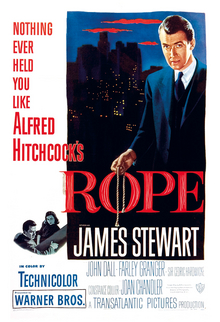


Like I had said before the play was adapted from the play Rope, which itself was said to be based on the grisly Leopold and Loeb case of 1924. Nathan Leopold and Richard Loeb were two upper class Chicago law students who murdered and innocent teenagers.  So in the movie Brandon and Phillip were the real life murders and they had considered themselves as Nietzschean supermen whose superiority of intellect exempted them from the laws that govern the rest of us. "Good and evil, right and wrong were invented for the ordinary average man, the inferior man, because he needs them", claims the character Brandon, who was clearly a deluded mastermind of murder. 

Ropes thrillers are characterized by fast pacing and frequent action. I wouldn't say that Rupert Cadell was a hero as he had believed the same things as the murders Brandon and Phillip believed, but he was the hero in this case as he figured out that Brandon and Phillip were the murders of the innocent man David. The murders were more equipped than the hero Rupert, as they had a gun towards the end leaving him empty handed.  


The devices such as suspense, red herring and cliffhangers were used extensively. Especially towards the end of the dinner, when the maid began to clear everything up , we knew that the person who was murdered was hidden in the wooden chest, but the maid never knew this. This created suspense because we were all weary on whether or not she was going to open the wooden chest or not. 


It also included dramatic irony, because we knew that Brandon and Phillip were murders but the characters within the movie never new this. It would have been more effective if the audience had known of this because it would have created more of a suspense as the audience would have been wondering who is actually the murder and when will we find out?

Hitchcock wanted the film to be a continuous play. The film Rope pretends to be a one-shot film, he shot periods lasting for up to 10 minutes (approximately the length of a film camera magazine) he was continuously panning from actor to actor. The segments usually ended by panning against or tracking into an object, for example a mans jacket which would block the entire screen or the back of a piece of furniture. The film has consisted of 10 segments. 

SegmentLengthTime-codeStartFinish
109:3400:02:30Close-up (CU), strangulationBlackout on Brandon's back
207:5100:11:59Black, pan off Brandon's backCU Kenneth: "What do you mean?"
307:1800:19:45Unmasked cut, men crossing to JanetBlackout on Kenneth's back
407:0800:27:15Black, pan off Kenneth's backCU Phillip: "That's a lie."
509:5700:34:34Unmasked cut, CU RupertBlackout on Brandon's back
607:3300:44:21Black, pan off Brandon's backThree shot
707:4600:51:56Unmasked cut, Mrs. Wilson: "Excuse me, sir."Blackout on Brandon
810:0600:59:44Black, pan off BrandonCU Brandon's hand in gun pocket
904:3701:09:51Unmasked cut, CU RupertBlackout on lid of chest
1005:3801:14:35Black, pan up from lid of chestEnd of film

This chunkiness can be part of the films claustrophobic strength though the coffin chest is rarely out of shot and the camera follows the actors around everywhere within the confined set. This makes the characters trapped as well as the audience. Hitchcock wanted the Rope to feel "live" with suspense that at any minute , one of the actors could do something unexpectedly such as forgetting their lines or even open the trunk which will leave it on a cliffhanger because the audience would want to know what happened next.

One innovative part of the film was the studio which contained a skyline-backdrop, with fibreglass clouds, a travelling sun and the neon light which blinked a garish red and green as the film reached it climax. It also used models of the Empire State building and the Chrysler building. And numerous chimney smoke, lights on in the buildings. He did this to make the film seem more realistic and less unrealistic.  

One of the narrative theories were included in the movie. For example the Classical Hollywood narratives were included in this because the film went it chronological order. It started with them murdering an innocent man, to them having to get through dinner with everyone wondering where David the murder victim was, and them being caught out in the end by the hero  Rupert. 


The group represented in the film were Gay/Straight. The two men in the movie were Gay but Hitchcock had to cover it up so that it wasn't to obvious to the audience. During the period the film was made there was a reference to t homosexuality was prohibited  by the production code. 

The Levi Strauss' idea of the binary opposition also appeared in the movie Rope. the idea of their being a dominant person and a subordinate person. In this case Brandon was more dominant than Phillip, this came across a lot in the film because after they had just murdered the innocent man Brandon was acting calmly about it like nothing had happened, but Phillip on the other hand was all rattled up and paranoid that they were going to get caught.

Hitchcock challenges the normal stereotype, usually people think that Upper Class people are innocent people that they would not be involved in something like murder. But Hitchcock proves them wrong by showing that just because they are Upper class, they are able to anything that a normal Second Class or Lower Class person would do.


Hitchcock used a lot of different type of  Camera Work, an example of this is the opening scene, he used a pan shot of the area they were living in:
https://www.youtube.com/watch?v=aJo5ih2HkxE

He also was required to edit the movie, for example when he was doing his takes, he takes were always long, they would usually last about 10 minutes long. 
https://www.youtube.com/watch?v=wCU6eNU6cck
In this clip it shows how long each take usually lasted. It also showed how he used sound effects, especially at the beginning when the two men were pursuing the killing.

The setting of the movie was in a beautiful apartment, im sure he also used hair and make up to make their actors/actress's look nice. He also made them wear clothing which suited the time the movie was made. And the facial experssion for example of Brandon and Phillip, you could clearly see that Brandon was the more dominant one in the relationship and Phillip was the one who was subordinate. Also his body posture was more slouched, whilst Brandon was more up right.
https://www.youtube.com/watch?v=kEGpN4_br-A






Monday, 6 October 2014

NORTH BY NORTH WEST

North by North West
Here is the trailer to the best thriller movie of all time:


The trailer is very different to the sort of trailer that we have now and days. This trailer is has someone explaining the movie and what you will be expecting throughout it. It introduces all the main characters like Cary Grant, who was one of the best actors out at that time. Even the poster for the movie, its very different to the posters we have now and days. As the poster shows a little piece of the movie on it.


The thriller movie North By North West was written by the famous Alfred Hitchcock often nicknamed the "Master of Suspense". 


He was boring in London, 1899, for a short time he worked as an engineer before entering into the film industry. He then moved to Hollywood, 1939, to produce his first ever film Rebecca which had won an Academy award for the best picture. Hitchcock he created over 5 films, these included films such as: Rear Window, The 339 Steps and psycho. In all of Hitchcock's films he planned every scene visually in advance. Before shooting Hitchcock had learned all the dialogue and had rarely had to look at the script.  also whenever he was directing he never had to look at the camera. Hitchcock had received the AFI's Life Achievement Award in 1979, but sadly passed in 1980.

Thrillers are usually characterized by  face pacing and frequent action, and this movie surely does include this. This movie included resourceful heroes who tried to thwart the plans of the more powerful equipped villains. It was shown when Roger Thornhill ( Cary Grant) was captured by Phillip Vandamm and their was more of them than him for him to even try to escape. 
Hitchcock also included devices such as suspense, for example the time where Roger Thornhill was being chased by the plane. H also used red herring, this was where we had all thought that the girl Eve Kendall ( Eva Marie Saint) was on the bad guys side, but really and truly she as on the good peoples side, also when she shot Roger, we wasn't expecting this to happen, but it did. Lastly he used the cliff hanger device, this was where Roger and Kendall were literally hanging off a cliff. We were all at the end of our seat wondering if they were going to survive or not. 
Hitchcock believed the stress on visual makes the cinema accessible in all different languages. Hitchcock likes the subjective viewpoint close ups on a face than what they are looking at, then another close up again as the character reacts to what has been see. Hitchcock said he wants to transfer the menace.
In the film North By North West he uses the Mount Rushmore as a symbol of order.


Hitchcock said that the audiences often need a relief from suspense pace of change or possibly a laugh. 
"A thriller is a villain driven plot where by he presents obstacles the hero must come over" This is shown in the auction scene. There were more of him than there were of R. Thornhill, so he tried to create a scene so that he could get arrested, seeing as he didn't have any weapons or any back up to back him up. This had then caused a diversion to the villain plot to how the villain tried to kill the hero. This does cause a build up of tension when it comes to the audience as they would like to see whether or not he survives these obstacles or not. 
There also something called the McGuffin, this is where the spies care about something which is very important to them, but however the audience don't care. All the audience care about is what will happen next? will he survive? hows he going to escape? for example this is due to all the suspense caused. This is showed when Roger Thornhill was at the auction, and he was outnumbered by the people who were after him, so this had left the audience thinking what is going to happen next and whether or not he was going to be able to escape them.
The movie could also include the Enigma, this where it leaves the audience wondering whether or not Roger Thornhill will be finally proven that he is not George Kaplan. This leaves the audience continuously hooked throughout the movie as they want to find out if he survives or not. This is good because then the audience will have no choice but to watch the film all the way to the end. 
The move does also include the Todorov, it starts when Roger Thornhill goes about his everyday life as he normally does, but then as soon as he answers to the name George Kaplan this then changes the whole equilibrium. Mr Thornhill is then forced into trying to prove that he is not George Kaplan throughout the whole movie and along the way he find a friend in a female who knew the whole time that he was not George Kaplan but she betrayed him as she was the girlfriend of the enemy. But finally at the end we find out that George Kaplan isn't a real person which changes the whole equilibrium of the story. 


Monday, 22 September 2014

GENRES

GENRES


Genre is a style or category of art, music or literature. For example you can get have genres for films which would be Thriller, Adventure or Sci- Fi. In music the different genres you can get are Hip Hop, Classical and Jazz Music. And then when it comes to literature you can have genres such as Comedy, Romance and Fairy Tales. But the main genres that I am going to be studying on are the film genres.

GUESS THE GENRE:


Thrillers
A thriller is a genre of a literature, film and a television programme, which usually contains suspense, tension and excitement. It normally contains a resourceful hero, a better equipped villain, a McGuffin, cliffhanger and a background music which goes at a very fast paced which causes adrenaline. This is especially used when it comes to the trailer of thriller movies, this is so that it can catch the eye of the audience so that they are intrigued by it and then they can go view it in the cinema. The red-herring in a movie is used to misguide the audience from the main plot and allows them to believe something else it about to occur. And then there is the McGuffin which drives the plot forward but has little significance.

The most common thrillers were made by the film director Alfred Hitchcock as he is known as the 'Master' of the thriller genre. He has made the most popular thrillers such as Psycho, North by Northwest and The Birds. In media we will be analyzing more thriller movies in more depth, and we will also be making one of our own.

Sub Genres
There are also sub- genres in thriller, so this includes:

  • Comedy Thrillers
  • Crime Thrillers
  • Psychological Thrillers
  • Romantic Thrillers
And many more.....


THRILLER CONVENTIONS

                                                                       Thriller Conventions

Thriller is a broad genre of literature films and television that includes numerous and often overlapping sub-genres. 

In Thriller movies they usually have fast pacing and frequent action. This is good because it keeps the audience entertained and interested in the movie and what is going on, as they don't want to miss out on what is going on. Thrillers also include resourceful heroes who must thwart the plans of more powerful and better equipped villains. This is good because they will be more engaged in what happens to that person, will he survive or no? In Thrillers they usually have a man as the main character who would also have an attractive young women along with him. So for example in the film Red the young man has a women along his side who he fell in love with. 
 A Thriller often has a villain driven plot. The villain present obstacles which the hero has to overcome, a good example of this is the James Bond film called Skyfall. This creates excitement to the audience because the

Thrillers also uses devices, such as red herring, this is where the audiences are fooled as well as the characters. In addition to that they use devices such as cliffhangers to keep the audience intrigued about whats going to happen next. And also suspense which leaves the audience feeling excited and anxious about what may happen next.The genre thriller is flexible and can change and it does engage the audience through dramatic rendering of psychological, social and political tensions. For example Hitchcock said "Thrillers allow the audience to put their toe in the cold water to fear to see what its like". 

At times thriller can sometimes be mixed up with mystery stories, however they both have a different structure to their plots. In a thriller the hero must thwart the future plans of the villain but in a mystery they have to uncover the crime which has already happened. When it comes to murder mysteries if we was to know the murders identity of the person then it would ruin the film, but in a thriller we do get to know the villain and we get to see how they get defeated, if they do. Usually the best bits of a thriller is the climax, this when the hero finally defeats the villain, saving his own life and maybe the life of others. Resulting in the audience receiving a sense of relief as the man character has been saved. 

Thrillers also have characteristics within their movie. Thrillers always usually take place in exotic settings such as foreign cities. An example of this is the film Taken which was set in Paris. The heroes in Thrillers are frequently "hard men" accustomed to danger e.g. policemen. But on the other hand they can also be ordinary citizens drawn into danger by accident. While such heroes have traditionally been men, women led characters have also become increasingly common: for an early example see journey weavers characters Ripely in the movie Alien in 1979. 


Thrillers differ from mystery murders this is because Thrillers often overlap with mystery murders, but they are distinguished by the structure of their plots. In a thriller the hero must thwart the future plans of the enemy rather than just uncovering the crime that has already happened. A murder story would be spoiled if we knew the murder's identity whereas in a thrillers the identity of a murder is already found out in beginning and they are trying to be stopped. Thrillers also normally occur on a much grander scale than mystery films: the crime that must be prevented are serial or mass murder, terrorism assassination or people trying to overthrow the government. Danger and violent confrontation are standard plot element of a thriller. Also the climaxes in thrillers are also different. 

Thrillers can be defined by the primary mood that they create fearful excitement. Basically if it "thrills" then it is a thriller.

There are all kinds of Thriller; legal thriller, spy thriller, action - adventure thriller, medical thriller, police thriller, romantic thriller, historical thriller, political thriller, religious thriller, high tech thriller, military thriller etc. The lis goes on with new new variations constantly being invented.  

Here are also 5 of the best Thriller movies: