Friday, 24 October 2014

AS MEDIA SOUND EXERCISE EVALUATION

AS MEDIA SOUND EXERCISE EVALUATION 


In our sound exercise we had to create a short scenes to try and include all of the sound technique within the scenes we have created. Within the short scene it had to include a short conversation. The main focus of the task we were given is the use of sound, so we had to carefully consider the dialogue and the sound effects e.g footsteps, door slamming etc.

These sound techniques consist of:

  • Diegetic - This is where it refers to the world of the text, for example the radio could be playing in the background.
  • Non Diegetic - This occurs when it refers to everything outside the world of the text, so this could include things such as voice overs, soundtracks, captions, titles and subtitles. 
  • On Screen - Is when the audience can see the source of the sound. 
  • Off Screen - When the audience cant see the source of the sound. 
   Both the On Screen and off Screen sound effects enables the extension of the diegetic world.
  • Parallel - Is the sound that matches what is happening within the action taking place. 
  • Contrapuntal - Is when the sound doesn't match what is taking place within the action which is taking place. 
  • Sound Bridge - Helps to create a smooth transition from one scene to another. The sound bridges the two scene together. 
Our short scenes was about a man who was avoiding a man who he owed money to, but these to men bump into each other. However the man escapes and tries to have the guy who he owes money to murdered. I tried to make sure that I included all of the sound techniques.

Scene 1: At the beginning of the scene I used a Non-Diegetic sound technique to introduce all the people who were involved in the short scene. Also in scene one I used diegetic sound to match with the world of the text. So when the young man is walking everything is calm as you could hear with the sounds of the birds in the background. You wouldn't think that anything bad is about to happen at this point.
Scene 2: In this scene we have the other young man who owes the other guy money. We used the On Screen sound to to show that he was listening to music in his headphones. We used the on screen sound so that the audience are able to know where the the source of the sound is coming from.
Scene 3: This is the scene where both of the men bump into each other. The music he's listening to then automatically stops. And the there's a bit of dialogue. Then as soon as the young man escapes there's an contrapuntal sound inputted which is to elaborate the fact that they are running, this is contrapuntal because the sound doesn't match the action of whats showing.
Scene 4: I then included a a sound bridge, this is is a smooth transition  from one scene to another. In this case he runs into a room and the music from the last scene is also included in this scene. There is also an off screen sound, this was where the phone call was being made, we couldn't see the phone which is why its a off screen sound technique.  And lastly I included the contrapuntal sound technique, this was when I used a dramatic sound effect to show that in that moment there was sense of panic but at the end everything turned out to be okay.

We decided that our scene would involve a conversation because we felt like this would be able to include all of the sound techniques in it. So for example in scene 2 we used the On Screen sound technique to show that Taju was listening to music, whilst on the other hand we used
diegetic sound to show that everything was calm and humble when Hayden was walking in. And then when they clashed the whole mood changed and everything got really intense.
The choices that we used in our conversation scene was really successful, because all of the sound techniques could be used which made it so much easier to edit it on the computer. For example when we the two young men were running it was easy to add a contrapuntal sound to it because we made sure that they was running for long enough to be able to add it.

When we were film our scene we made sure that we captured the sound effectively, this was shown when we filmed Taju running into the room and making the phone call. We made sure that you were able to hear the sound of him dialing the number, to show that this was Off Screen sound effect and we also made sure that it was clear to see. When it came to using the sound equipment, we made sure that we was doing it correctly. This is proven when we could clearly hear Hayden and Taju speak, if it wasn't due to the sound equipment we were using then we wouldn't be able to hear t he clearly or hear them at all for that matter.
We correctly differentiated between Non-Diegetic and Diegetic sound, so at the beginning of the short scene I made sure that I put a introduction of all the characters who were involved in the scene and also the people who helped produce the scene as well. And when it came to the Diegetic sound this was when we showed that Hayden was within a peaceful and calm environment.
We also made sure that we differentiated the differences between On Screen sound and Off Screen sound, this was shown when Taju walked in listen to music, so we showed which song he was listening to, the audience can clearly see this is an on Screen sound because they are able to see where the source of the sound is coming from. But when it came to the Off Screen sound we could also clearly see this, this was when Taju was making the phone call in a dark room, we could hear the sound of him dialing on the phone however we could see the phone that he was dialing from. This is why this is a Off Screen sound technique because we are not able to see the source of sound. And lastly we made sure that we were able to include a sound bridge, this was when Taju and Hayden were running and their was a backing sound effect and then as soon as he ran into the room the sound effect was still going on when he ran into the room.

The most positive elements of my film would have to be when Taju was in the room on the phone to the to a friend of his, this was postive becasue it brought a sense of entertainment to our film piece. 

Wednesday, 15 October 2014

CAMERA EXERCISE

What we did?

In this exercise we showed all the different camera shots, and how they are presented through films, these included:
  • Long Shot - This is a shot which is taken from far away
  • Medium Shot - This is a shot where the person is not close up but is not far away
  • Close Up -  A shot where it has been taken up close
  • Extreme Close Up - A shot which has been take extremely close, so for example a shot of the eyes. 
  • Point of View (POV) - We are able to see what the actor is seeing
  • Over the Shoulder - Looking over the shoulder of someone to see the other person talking
  • Low Angle - Is a shot taken from below to make a person seem as if they're in control. 
  • High Angle - Is a shot taken from above, to make someone look vulnerable
  • Pan - Right to Left/ Left to Right, Goes round
  • Tilt - Tilting the camera either up or down
  • Crane Shot - Very high angle looking at someone/ something e.g. helicopter
  • Tracking Shot - Following someone around with the camera
  • Rolling Shot - Like someone falling, moving sideways gradually, or very quickly
In my group we made sure that we had videoed all the shots above. After that we put all the shots that we videoed and we edited it altogether and we put titles at the bottom so that you were able to see which shot was which. We chose to do all the shots so that when it comes to looking back on the shots we will know which shot is which and we made sure that we did all of the shots. 

When it came to the shot then we will did not tell a story, this was because we wanted to make sure that we got each shot in the video, and we wanted to be able to get a feel of what it was like to use a camera, and the different shots. I believe that our video was a success because we made sure that we completed the task, which was to make sure that we include all the different shots. This had a positive outcome at the end of the day because now we understand how and at which moment we can use these different shots. 

Our negatives: 
In this short clip that we did with all the different shots in it, and we understood how each shot we should be used. However if there was supposed to be any improvement on the task we did then we should have at least had a story behind it, so that it would have been more entertaining for us and it would sit in our minds more. But overall I feel that it as a whole we did very well.

Also when it came to filming we had to make sure that we kept the camera as steady as possible, but unfortunately we wasn't able to achieve this in every shot, so this could be another fault in the task that we was supposed to fulfil. Each shot was taken appropriately but I believe that we need to improve on the techniques of how we film and also the area that we film. 

Tuesday, 7 October 2014

ROPE

Rope
Here's the trailer to the thriller movie Rope another Alfred Hitchcock Movie: 
https://www.youtube.com/watch?v=8NLsbzhOEHg

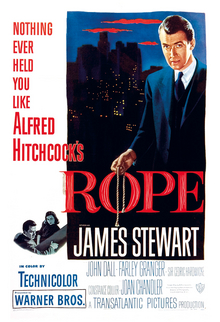
The trailer is different to the sort of trailers we have now and days. As you can see the trailer of this movie has less quality than the sort of movie that we have now. This is because the movie is a very old movie, being released in 1948. It was based on the play Rope by Patrick Hamilton. It includes film stars such as James Stewart, John Dall and Farley Granger. Even the poster for the film shows a sense that the film will be a thriller seeing as it has a dark surrounding to it, with just one character to it. You would think that he was the person committing all the crimes, but he wasn't. 


Like I had said before the play was adapted from the play Rope, which itself was said to be based on the grisly Leopold and Loeb case of 1924. Nathan Leopold and Richard Loeb were two upper class Chicago law students who murdered and innocent teenagers.  So in the movie Brandon and Phillip were the real life murders and they had considered themselves as Nietzschean supermen whose superiority of intellect exempted them from the laws that govern the rest of us. "Good and evil, right and wrong were invented for the ordinary average man, the inferior man, because he needs them", claims the character Brandon, who was clearly a deluded mastermind of murder. 

Ropes thrillers are characterized by fast pacing and frequent action. I wouldn't say that Rupert Cadell was a hero as he had believed the same things as the murders Brandon and Phillip believed, but he was the hero in this case as he figured out that Brandon and Phillip were the murders of the innocent man David. The murders were more equipped than the hero Rupert, as they had a gun towards the end leaving him empty handed.  


The devices such as suspense, red herring and cliffhangers were used extensively. Especially towards the end of the dinner, when the maid began to clear everything up , we knew that the person who was murdered was hidden in the wooden chest, but the maid never knew this. This created suspense because we were all weary on whether or not she was going to open the wooden chest or not. 


It also included dramatic irony, because we knew that Brandon and Phillip were murders but the characters within the movie never new this. It would have been more effective if the audience had known of this because it would have created more of a suspense as the audience would have been wondering who is actually the murder and when will we find out?

Hitchcock wanted the film to be a continuous play. The film Rope pretends to be a one-shot film, he shot periods lasting for up to 10 minutes (approximately the length of a film camera magazine) he was continuously panning from actor to actor. The segments usually ended by panning against or tracking into an object, for example a mans jacket which would block the entire screen or the back of a piece of furniture. The film has consisted of 10 segments. 

SegmentLengthTime-codeStartFinish
109:3400:02:30Close-up (CU), strangulationBlackout on Brandon's back
207:5100:11:59Black, pan off Brandon's backCU Kenneth: "What do you mean?"
307:1800:19:45Unmasked cut, men crossing to JanetBlackout on Kenneth's back
407:0800:27:15Black, pan off Kenneth's backCU Phillip: "That's a lie."
509:5700:34:34Unmasked cut, CU RupertBlackout on Brandon's back
607:3300:44:21Black, pan off Brandon's backThree shot
707:4600:51:56Unmasked cut, Mrs. Wilson: "Excuse me, sir."Blackout on Brandon
810:0600:59:44Black, pan off BrandonCU Brandon's hand in gun pocket
904:3701:09:51Unmasked cut, CU RupertBlackout on lid of chest
1005:3801:14:35Black, pan up from lid of chestEnd of film

This chunkiness can be part of the films claustrophobic strength though the coffin chest is rarely out of shot and the camera follows the actors around everywhere within the confined set. This makes the characters trapped as well as the audience. Hitchcock wanted the Rope to feel "live" with suspense that at any minute , one of the actors could do something unexpectedly such as forgetting their lines or even open the trunk which will leave it on a cliffhanger because the audience would want to know what happened next.

One innovative part of the film was the studio which contained a skyline-backdrop, with fibreglass clouds, a travelling sun and the neon light which blinked a garish red and green as the film reached it climax. It also used models of the Empire State building and the Chrysler building. And numerous chimney smoke, lights on in the buildings. He did this to make the film seem more realistic and less unrealistic.  

One of the narrative theories were included in the movie. For example the Classical Hollywood narratives were included in this because the film went it chronological order. It started with them murdering an innocent man, to them having to get through dinner with everyone wondering where David the murder victim was, and them being caught out in the end by the hero  Rupert. 


The group represented in the film were Gay/Straight. The two men in the movie were Gay but Hitchcock had to cover it up so that it wasn't to obvious to the audience. During the period the film was made there was a reference to t homosexuality was prohibited  by the production code. 

The Levi Strauss' idea of the binary opposition also appeared in the movie Rope. the idea of their being a dominant person and a subordinate person. In this case Brandon was more dominant than Phillip, this came across a lot in the film because after they had just murdered the innocent man Brandon was acting calmly about it like nothing had happened, but Phillip on the other hand was all rattled up and paranoid that they were going to get caught.

Hitchcock challenges the normal stereotype, usually people think that Upper Class people are innocent people that they would not be involved in something like murder. But Hitchcock proves them wrong by showing that just because they are Upper class, they are able to anything that a normal Second Class or Lower Class person would do.


Hitchcock used a lot of different type of  Camera Work, an example of this is the opening scene, he used a pan shot of the area they were living in:
https://www.youtube.com/watch?v=aJo5ih2HkxE

He also was required to edit the movie, for example when he was doing his takes, he takes were always long, they would usually last about 10 minutes long. 
https://www.youtube.com/watch?v=wCU6eNU6cck
In this clip it shows how long each take usually lasted. It also showed how he used sound effects, especially at the beginning when the two men were pursuing the killing.

The setting of the movie was in a beautiful apartment, im sure he also used hair and make up to make their actors/actress's look nice. He also made them wear clothing which suited the time the movie was made. And the facial experssion for example of Brandon and Phillip, you could clearly see that Brandon was the more dominant one in the relationship and Phillip was the one who was subordinate. Also his body posture was more slouched, whilst Brandon was more up right.
https://www.youtube.com/watch?v=kEGpN4_br-A


Monday, 6 October 2014

NORTH BY NORTH WEST

North by North West
Here is the trailer to the best thriller movie of all time:


The trailer is very different to the sort of trailer that we have now and days. This trailer is has someone explaining the movie and what you will be expecting throughout it. It introduces all the main characters like Cary Grant, who was one of the best actors out at that time. Even the poster for the movie, its very different to the posters we have now and days. As the poster shows a little piece of the movie on it.


The thriller movie North By North West was written by the famous Alfred Hitchcock often nicknamed the "Master of Suspense". 


He was boring in London, 1899, for a short time he worked as an engineer before entering into the film industry. He then moved to Hollywood, 1939, to produce his first ever film Rebecca which had won an Academy award for the best picture. Hitchcock he created over 5 films, these included films such as: Rear Window, The 339 Steps and psycho. In all of Hitchcock's films he planned every scene visually in advance. Before shooting Hitchcock had learned all the dialogue and had rarely had to look at the script.  also whenever he was directing he never had to look at the camera. Hitchcock had received the AFI's Life Achievement Award in 1979, but sadly passed in 1980.

Thrillers are usually characterized by  face pacing and frequent action, and this movie surely does include this. This movie included resourceful heroes who tried to thwart the plans of the more powerful equipped villains. It was shown when Roger Thornhill ( Cary Grant) was captured by Phillip Vandamm and their was more of them than him for him to even try to escape. 
Hitchcock also included devices such as suspense, for example the time where Roger Thornhill was being chased by the plane. H also used red herring, this was where we had all thought that the girl Eve Kendall ( Eva Marie Saint) was on the bad guys side, but really and truly she as on the good peoples side, also when she shot Roger, we wasn't expecting this to happen, but it did. Lastly he used the cliff hanger device, this was where Roger and Kendall were literally hanging off a cliff. We were all at the end of our seat wondering if they were going to survive or not. 
Hitchcock believed the stress on visual makes the cinema accessible in all different languages. Hitchcock likes the subjective viewpoint close ups on a face than what they are looking at, then another close up again as the character reacts to what has been see. Hitchcock said he wants to transfer the menace.
In the film North By North West he uses the Mount Rushmore as a symbol of order.


Hitchcock said that the audiences often need a relief from suspense pace of change or possibly a laugh. 
"A thriller is a villain driven plot where by he presents obstacles the hero must come over" This is shown in the auction scene. There were more of him than there were of R. Thornhill, so he tried to create a scene so that he could get arrested, seeing as he didn't have any weapons or any back up to back him up. This had then caused a diversion to the villain plot to how the villain tried to kill the hero. This does cause a build up of tension when it comes to the audience as they would like to see whether or not he survives these obstacles or not. 
There also something called the McGuffin, this is where the spies care about something which is very important to them, but however the audience don't care. All the audience care about is what will happen next? will he survive? hows he going to escape? for example this is due to all the suspense caused. This is showed when Roger Thornhill was at the auction, and he was outnumbered by the people who were after him, so this had left the audience thinking what is going to happen next and whether or not he was going to be able to escape them.
The movie could also include the Enigma, this where it leaves the audience wondering whether or not Roger Thornhill will be finally proven that he is not George Kaplan. This leaves the audience continuously hooked throughout the movie as they want to find out if he survives or not. This is good because then the audience will have no choice but to watch the film all the way to the end. 
The move does also include the Todorov, it starts when Roger Thornhill goes about his everyday life as he normally does, but then as soon as he answers to the name George Kaplan this then changes the whole equilibrium. Mr Thornhill is then forced into trying to prove that he is not George Kaplan throughout the whole movie and along the way he find a friend in a female who knew the whole time that he was not George Kaplan but she betrayed him as she was the girlfriend of the enemy. But finally at the end we find out that George Kaplan isn't a real person which changes the whole equilibrium of the story.